Dr. Sparsh Sharma — DLR Braunschweig

The mathematics
of turbulent noise

I build mathematical, stochastic, and computational frameworks to understand why turbulent flows generate sound—and what can be done about it. From vortex particle methods to porous-material acoustics, the approach is always physics-first.

∂²ρ′/∂t² − c₀²∇²ρ′ = ∂²Tᵢⱼ/∂xᵢ∂xⱼ

Tᵢⱼ = ρuᵢuⱼ + pᵢⱼ − c₀²ρ′δᵢⱼ

// Turbulence as a quadrupole source
// Pressure fluctuations as observable

Bridging the Navier–Stokes equations and acoustics—the central problem of aeroacoustics.

Turbulence Modelling· Aeroacoustics· Vortex Dynamics· Stochastic Methods· LES / DES / DNS· Leading-Edge Noise· Porous Materials· Wind Energy· Reduced-Order Modelling· Turbulence Modelling· Aeroacoustics· Vortex Dynamics· Stochastic Methods· LES / DES / DNS· Leading-Edge Noise· Porous Materials· Wind Energy· Reduced-Order Modelling·

Turbulence is not just a flow problem. It is a problem in stochastic mechanics, spectral theory, and statistical physics.

My research sits at the intersection of fluid mechanics, mathematical physics, and numerical methods. The central question driving my work: how does the chaotic, multiscale structure of turbulence produce sound—and can we predict, model, and control it without solving everything at once?

I pursue this across three connected tracks: mathematical modelling (stochastic Markov-chain turbulence, vortex particle methods, Lighthill's analogy), computational simulation (LES, DES, FW-H, ODT), and physical experiments (wind tunnel, airfoil-turbulence interaction, porous coatings). The result is a research programme that can move between a tensor identity and a wind turbine blade without losing rigour.

Explore the research →
8+ Peer-reviewed journal papers
15+ Conference & proceedings papers
7 Journals reviewed for (incl. JFM, PoF)
4 Master's theses supervised
DFG Walter Benjamin Fellow, Cambridge

Five connected problems,
one coherent programme

01

Leading-Edge Noise & Turbulence–Airfoil Interaction

Stochastic vortex particle methods for predicting airfoil noise from incoming turbulence. Time-domain BEM, validated against experiment.

Read more →
02

Stochastic Turbulence & One-Dimensional Turbulence

ODT as a reduced-order model for jet self-noise. Markov-chain representations of turbulent velocity fluctuations and their acoustic signatures.

Read more →
03

Porous Materials for Passive Noise Control

How porous coatings suppress vortex shedding and far-field noise in cylinders and bluff bodies. Permeability, thickness, and geometric effects.

Read more →
04

High-Fidelity Computational Aeroacoustics

LES, DES, DNS, and FW-H acoustic analogies for airframe, fan, and wind-turbine noise. Tool development in SU2, OpenFOAM, and Python.

Read more →
05

Turbulent Jets & Jet Noise Prediction

Self-similarity, far-downstream velocity statistics, and acoustic emission from turbulent round jets at high Reynolds number.

Read more →
06

Wind Energy Aeroacoustics

Turbulent inflow and trailing-edge noise from wind turbine blades. Experimental and numerical validation at DLR Braunschweig.

Read more →

Turbulence as a mathematical object, sound as its physical consequence

My research develops physics-based mathematical and computational frameworks for understanding, predicting, and controlling the noise generated by turbulent flows. The problems are fundamental; the tools are often novel.

Stochastic methods

Markov chains, Langevin equations, Monte Carlo sampling, and ODT for turbulence statistics without resolving all scales.

Vortex particle methods

Lagrangian, meshless solvers for Euler and Navier–Stokes equations. Synthetic turbulence generation.

High-fidelity CFD

LES, DES, DNS using OpenFOAM, SU2. Scale-resolving simulations for aeroacoustic analysis.

Acoustic analogies

Lighthill, FW-H, BEM. Connecting flow solutions to far-field sound radiation in a mathematically rigorous way.

Leading-Edge Noise & Turbulence–Airfoil Interaction

When a turbulent flow meets an airfoil's leading edge, how do we predict the radiated sound without resolving every vortex?

This is the thread that runs from my doctoral thesis to the present. I developed a stochastic, time-domain approach using vortex particles as both a turbulence representation and an acoustic source model. The key insight is that a Lagrangian description of turbulence—individual vortex elements with prescribed statistics—is both physically transparent and computationally tractable.

The resulting framework produces broadband noise predictions that compare well with high-fidelity LES at orders-of-magnitude lower cost. It has been extended to handle realistic turbulent spectra, anisotropic inflow, and experimental validation against wind-tunnel measurements.

More recently at DLR, the vortex particle method has been augmented with a look-up table approach to further accelerate turbulent inflow and leading-edge interaction noise prediction for aircraft high-lift devices and wind turbine applications.

Key methods
  • Lagrangian vortex particle method
  • Stochastic turbulence synthesis
  • Time-domain boundary element method
  • Ffowcs Williams–Hawkings analogy
  • Wind-tunnel validation
Representative papers
  • Sharma & Sarradj, Phys. Rev. Fluids (2019)
  • Sharma, Sarradj & Schmidt, JSV (2020)
  • Sharma & Herr, J. Phys.: Conf. Ser. (2024)
Why it matters
  • Wind turbine blade noise — a major societal constraint on placement and scale
  • Aircraft high-lift noise during approach
  • Enables rapid parametric noise studies at design stage

Stochastic Turbulence Modelling & One-Dimensional Turbulence

Can a one-dimensional stochastic process—retaining turbulent intermittency, energy cascades, and self-similarity—serve as a faithful reduced-order model for aeroacoustic prediction?

One-Dimensional Turbulence (ODT) is a stochastic closure model developed by Kerstein. Unlike classical eddy-viscosity approaches, ODT directly simulates turbulent advection via stochastic rearrangement events on a 1D domain—preserving the physical mechanisms of the energy cascade without the cost of 3D DNS.

My work during the Cambridge postdoc (DFG Walter Benjamin Fellowship) applied ODT to investigate turbulent jet dynamics: self-similar velocity statistics, far-downstream fluctuations, and—crucially—their acoustic emission via Lighthill's equation. This is a principled way to bridge the gap between low-order turbulence models and the acoustic field, with explicit probabilistic treatment of source fluctuations.

The goal is a framework where turbulence is not parametrised but modelled as a stochastic process with physical fidelity, producing acoustic predictions with quantifiable uncertainty.

Key methods
  • One-dimensional turbulence (ODT)
  • Lighthill's acoustic analogy
  • Markov chain turbulence modelling
  • Statistical self-similarity analysis
  • Spectral analysis of velocity fluctuations
Representative papers
  • Sharma, Klein & Schmidt, Phys. Fluids (2022)
  • Medina Méndez, Sharma et al., PAMM (2023)
  • Sharma, Ayton, Klein et al., INTER-NOISE (2023)
Collaborators
  • Prof. Marten Klein (BTU Cottbus)
  • Dr. Lorna Ayton (Cambridge)
  • Prof. Heiko Schmidt (BTU Cottbus)

Porous Materials for Passive Flow & Noise Control

How do the porous microstructure, thickness, and permeability of a coating alter the vortex dynamics around a bluff body—and how does this translate to acoustic suppression in the far field?

Porous coatings offer a passive, structurally simple route to noise control. Owls—nature's model—use porous wing structures to fly nearly silently. The aeroacoustic engineering challenge is to understand the mechanism precisely enough to design effective coatings without trial and error.

My computational studies (DES, FW-H) on porous-coated cylinders and staggered cylinder configurations show that coating permeability and thickness act on distinct physical mechanisms: permeability suppresses vortex shedding regularity while thickness affects the mean velocity distribution and acoustic source distribution.

This work was conducted in collaboration with experimental colleagues and has direct application to airframe landing-gear noise and wind turbine strut noise.

Key methods
  • Detached Eddy Simulation (DES)
  • FW-H acoustic analogy
  • Porous medium modelling (Darcy/Forchheimer)
  • Far-field acoustic beamforming (experimental)
Representative papers
  • Sharma, Geyer & Arcondoulis, JSV (2022)
  • Geyer, Sharma & Sarradj, AIAA/CEAS (2018)
  • Sharma, Geyer & Arcondoulis, AIAA/CEAS (2022)

High-Fidelity Computational Aeroacoustics

How accurately can we predict aeroacoustic sources and far-field noise using scale-resolving simulations—and where do turbulence closures break down?

Complementing the mathematical modelling track, I maintain strong capability in high-fidelity computation. This includes LES/DES in OpenFOAM and SU2, acoustic post-processing via FW-H, and grid-generated turbulence simulations to benchmark turbulence modelling assumptions.

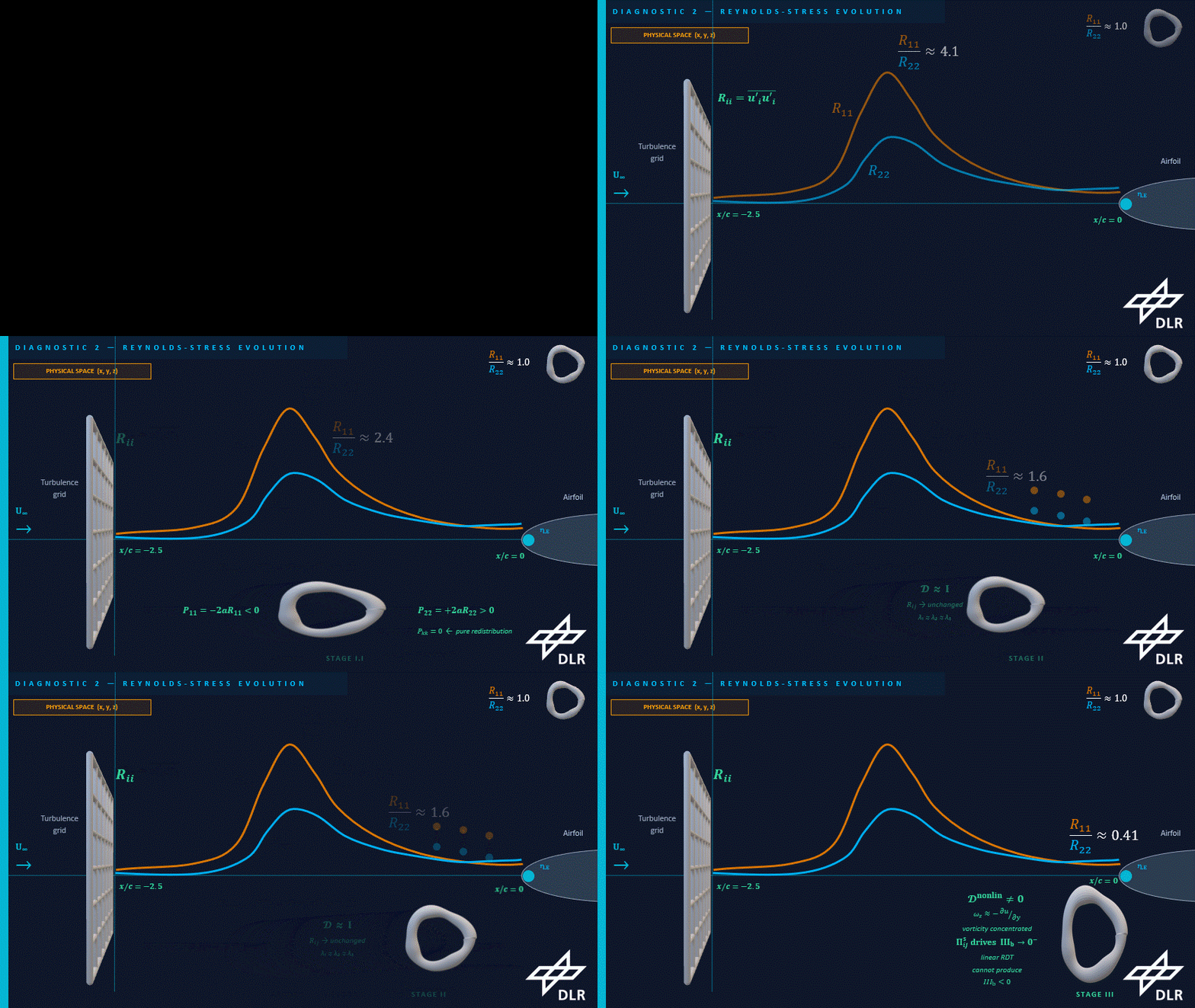
A recent focus at DLR has been assessing Navier–Stokes turbulence model fidelity for grid-generated turbulence interacting with an airfoil—a critical validation case for wind turbine and aircraft inflow noise predictions. The question of where and how turbulence models fail is as important as what they predict correctly.

Tools
  • OpenFOAM (LES, DES, RANS)
  • SU2 (DES, FW-H)
  • ANSYS CFX/Fluent
  • Python (Numpy, Scipy, Pytorch)
  • Paraview, Tecplot
Representative papers
  • Sharma, Suryadi & Herr, AIAA/CEAS (2024)
  • Sharma, Geyer et al., AIAA/CEAS (2019)
  • Sharma, Geyer & Giesler, Appl. Acoustics (2021)

Publications

Organized thematically. Each entry includes a brief note on scientific significance. For full citation lists, see Google Scholar [TO BE LINKED] or download my CV.

Journal articles
J. Phys.: Conf. Ser. 2024

Efficient prediction of turbulent inflow and leading-edge interaction noise using a vortex particle method with look-up table approach

S. Sharma, M. Herr
Extends the vortex particle framework to DLR-scale computations via a look-up table, dramatically reducing wall time while preserving prediction accuracy for turbulent inflow noise.
PAMM 2023

Toward the use of a reduced-order and stochastic turbulence model for assessment of far-field sound radiation: Low Mach number jet flows

J.A. Medina Méndez, S. Sharma, H. Schmidt, M. Klein
Connects the ODT turbulence model to far-field acoustic radiation for the first time in the jet noise context—a significant step toward physics-based, low-cost jet noise prediction.
Journal of Sound and Vibration 2022

On the influence of porous coating thickness and permeability on passive flow and noise control of cylinders

S. Sharma, T.F. Geyer, E. Arcondoulis
A systematic parametric study that isolates permeability and thickness as distinct control parameters for aeroacoustic noise reduction—directly applicable to bluff-body airframe noise.
Physics of Fluids 2022

Features of far-downstream asymptotic velocity fluctuations in a round jet: A one-dimensional turbulence study

S. Sharma, M. Klein, H. Schmidt
Demonstrates that ODT faithfully reproduces the self-similar turbulent statistics in the far field of a round jet—validating the stochastic framework as a physics-faithful alternative to DNS.
Journal of Sound and Vibration 2020

Stochastic modelling of leading-edge noise in time-domain using vortex particles

S. Sharma, E. Sarradj, H. Schmidt
The central result of the doctoral thesis. Establishes the time-domain stochastic vortex particle method as a viable, physics-based alternative to high-fidelity LES for leading-edge noise prediction. A methodologically novel paper in aeroacoustics.
Physical Review Fluids 2019

Two-dimensional isotropic turbulent inflow conditions for the vortex particle method

S. Sharma, E. Sarradj
A foundational methodological paper. Derives mathematically consistent isotropic turbulent inflow statistics in 2D for Lagrangian solvers—enabling the entire vortex particle leading-edge noise programme.
Applied Acoustics 2021

Effect of geometric parameters on the noise generated by rod–airfoil configuration

S. Sharma, T.F. Geyer, J. Giesler
A benchmark study for the rod–airfoil configuration—one of the standard test cases for aeroacoustic simulations—investigating how geometric separation and alignment affect noise generation.
Selected conference & proceedings papers
AIAA/CEAS Aeroacoustics 2024

Assessment of turbulence modeling in Navier–Stokes simulations for grid-generated turbulence and airfoil interaction

S. Sharma, A. Suryadi, M. Herr
INTER-NOISE · Chiba, Japan 2023

A theoretical study of self-noise generation in turbulent jets using one-dimensional turbulence and Lighthill's acoustic analogy

S. Sharma, L. Ayton, M. Klein, J.A. Medina Méndez
AIAA AVIATION Forum 2021

Modelling turbulent jets at high Reynolds number using one-dimensional turbulence

S. Sharma, M. Klein, H. Schmidt
AIAA AVIATION Forum 2021

Experimental validation of a lower-order model for leading-edge noise based on vortex method

S. Sharma, T.F. Geyer, E. Sarradj, H. Schmidt
AIAA/CEAS Aeroacoustics · Southampton 2022

Effect of coating thickness on aerodynamic noise reduction by porous-coated cylinders

S. Sharma, T.F. Geyer, E. Arcondoulis
AIAA/CEAS Aeroacoustics · Reston 2019

Numerical investigation of noise generation by rod–airfoil configuration using DES (SU2) and the FW-H analogy

S. Sharma, T.F. Geyer, E. Sarradj, H. Schmidt
Doctoral thesis
BTU Cottbus-Senftenberg · summa cum laude 2020

Stochastic modelling of leading-edge noise in time-domain using vortex particles

S. Sharma — Supervisors: Prof. E. Sarradj, Prof. H. Schmidt, Prof. U. Harlander
Awarded the Best Thesis Prize 2020 by Brandenburg Technical University. Available open access via BTU repository.

Scientific talks

Invited seminars, conference presentations, and workshops.

Invited seminars
Mathematics of noise in a turbulent jet
Applied Mathematics Seminar · University of Cambridge, UK · 2022
Invited
Dominant sources of noise in a turbulent jet
Fluid Mechanics Seminar · University of Cambridge, UK · 2022
Invited
Stochastic modelling of leading-edge noise
Aeroacoustics Seminar · IIT Jammu, India · 2019
Invited
Lighthill's equation and one-dimensional turbulence
Research Seminar · TU Berlin, Germany · 2021
Invited

Conference presentations
Fluctuating inflow condition for time-domain BEM for airfoil–turbulence interaction noise
ISUAAAT15 · University of Oxford, UK · 2018
Conference
Fluctuating inflow condition for time-domain BEM for airfoil–turbulence interaction noise
XNOISE · TU Vienna, Austria · 2017
Conference
Reduced-order modelling of noise generation from airfoil
Semester Seminar · BTU Cottbus, Germany · 2017
Seminar
Leading-edge noise
Engineering Acoustics Seminar 2017 · TU Berlin, Germany
Seminar
Self-similarity indications in a turbulent jet using one-dimensional turbulence
14th European Fluid Mechanics Conference (EFMC14) · Athens · 2022
Conference

Software & code

Research code developed as part of my scientific programme. Most is open-source on GitHub.

Turbulence synthesis

Synthetic Vorton Turbulence Model

PythonNumPy

Generates turbulent inflow conditions using Gaussian-profile vortex elements (vortons). Produces statistically correct energy spectra for use in leading-edge noise simulations.

GitHub →
Lagrangian solver

Vortex Particle Solver for Euler Equations

PythonC++

A 2D meshless Lagrangian solver for the incompressible Euler equations using the vortex particle method. Foundational tool for the time-domain leading-edge noise framework.

GitHub →
Aeroacoustics

Ffowcs Williams–Hawkings Acoustic Solver

Python

Computes directivity patterns of radiated sound pressure from airfoils using the FW-H acoustic analogy. Post-processes CFD surface data to far-field sound predictions.

GitHub →

I believe computational results should be reproducible. Where journal policies and data agreements permit, the code and data associated with published papers are made available via GitHub or data repositories. If you are trying to reproduce a specific result and cannot find the relevant code, please get in touch.

Dr. Sparsh Sharma

Research Scientist
DLR — German Aerospace Center
Institute of Aerodynamics and Flow Technology
2023 — present · Braunschweig, Germany
Group: Michaela Herr & Jan Delfs

Scientific biography

I am a research scientist at the Institute of Aerodynamics and Flow Technology at DLR Braunschweig, where I work in the aeroacoustics group of Dr. Michaela Herr and Prof. Jan Delfs on turbulent noise from aircraft high-lift systems and wind turbines.

My research is unified by a single question: how does the chaotic, multi-scale structure of turbulence give rise to sound—and can we model this process mathematically, without losing physical meaning? This has led me to develop Lagrangian vortex particle methods, stochastic Markov-chain turbulence models, and one-dimensional turbulence approaches as computational and theoretical tools for aeroacoustic prediction.

Before DLR, I held a DFG Walter Benjamin Postdoctoral Fellowship at the Department of Applied Mathematics and Theoretical Physics at the University of Cambridge (2021–2023), working on the mathematics of jet noise with Prof. Lorna Ayton and Prof. Marten Klein. The Cambridge period deepened my connection between mathematical physics and turbulence modelling—particularly through ODT and Lighthill's acoustic analogy.

My PhD (summa cum laude, BTU Cottbus & TU Berlin, 2016–2019) established the time-domain stochastic vortex particle method for predicting leading-edge noise from turbulence–airfoil interaction—work that was recognised with the BTU Best Thesis Award 2020 and the DEGA Young Scientist Award 2019.

I studied Computational Mechanics at MIPT Moscow (M.Sc., 9.5/10) and Mechanical Engineering at VIT Vellore (B.Tech., honours), where I first encountered the frustrating beauty of turbulence. Between degrees, I spent time at Rolls-Royce Aeroengines working on fan and airframe noise, and led R&D aeroacoustics collaborations at ebm-papst—experience that grounds my theoretical work in engineering reality.

I have supervised four master's theses, lectured an advanced CFD course at BTU Cottbus for three years, and review for seven journals including Journal of Fluid Mechanics and Physics of Fluids.

2023–present

Research Scientist, DLR Braunschweig

Institute of Aerodynamics and Flow Technology. Wind turbine and aircraft aeroacoustics.

2021–2023

DFG Walter Benjamin Fellow, University of Cambridge

DAMTP. Jet noise, ODT, Lighthill's analogy. With Prof. Ayton & Prof. Klein.

2020–2021

Postdoctoral Researcher, BTU Cottbus

Numerical Flow and Gas Dynamics. Jet turbulence modelling with Prof. Schmidt.

2016–2019

PhD (summa cum laude), BTU Cottbus & TU Berlin

Stochastic vortex particle method for leading-edge noise. Supervisors: Sarradj, Schmidt, Harlander.

2014–2016

M.Sc. Computational Mechanics, MIPT Moscow

Grade: 9.5/10. Aerodynamics, CFD, aeroacoustics, numerical methods.

2010–2014

B.Tech. Mechanical Engineering, VIT Vellore

Honours in Automotive Engineering. SAE Revathy Iyer Award; NASA N+3 competition.

Contact

I am based at DLR Braunschweig and am always open to scientific discussion, collaboration, or speaking invitations.

Open to collaboration on

I am particularly interested in working with researchers and groups on:

  • Turbulence–structure interaction noise (airfoil, blade, landing gear)
  • Wind energy aeroacoustics and noise mitigation
  • Stochastic turbulence modelling and reduced-order methods
  • Machine learning emulators for aeroacoustics
  • Porous material design for flow control
  • High-fidelity LES/DNS campaigns for noise source characterisation

For prospective students

If you are interested in pursuing a master's thesis or internship in computational aeroacoustics or turbulence modelling, please send a brief description of your background and interests alongside your CV. I am particularly interested in students with a strong mathematical background and familiarity with Python or C++.